5 days after my wife passed away, I started going through her things. When I moved her wardrobe, I found a hidden room behind it. Right then, my son called me. “Dad, get outside right now. I’m on my way. Don’t touch anything.” But I had already opened that door, and I saw…
5 days after I buried my wife, I was still wearing the same gray sweater I had put on the morning of her funeral. Not because I had forgotten to change it, because changing it felt like agreeing that life was moving forward, and I was not ready to agree to that yet.
My name is Irving Malone. I am 63 years old. I spent 31 years building a freight brokerage out of a single office in Worcester, Ohio. Two desks, a phone system, and a handshake reputation that eventually became something worth selling.
I sold Malone Freight Partners in 2021 and retired to the house where Dolores and I had raised our son. I believed at that point that the hardest thing I would ever face was the morning I got her diagnosis. I was wrong.
The hardest thing was the morning I found out what our son had been doing with my name while she was dying.
But I am getting ahead of myself.
Dolores passed on a Tuesday in October. We had been married 38 years. The last 14 months of those years were the kind that hollows a person. Doctors and treatment centers, and the particular exhausted tenderness that comes from watching someone you love fight something that refuses to be beaten.
She fought it with the same quiet determination she had brought to everything in her life. My wife was not a loud woman. She was a careful one.
That distinction mattered more than I understood at the time.
On the fifth day after her funeral, I finally walked into our bedroom with the intention of beginning. Her grief counselor at the hospital had told me there was no timeline. But I could smell her perfume every time I opened the door.
Something with Gardinia in it that she had worn for 20 years, and I knew I was either going to go in and face it or keep sleeping on the pull out in the den until the house decided for me.
I started with the dresser, then the nightstand. I worked slowly. The way you work when every object has a memory attached to it that swings at you the moment you pick it up.
Her reading glasses. A birthday card I had given her in 2019 that she had kept in the drawer because she said the way I signed it made her laugh. A small amber prescription bottle with three pills still rattling inside it that I could not bring myself to open.
It was the cedar wardrobe that changed everything.
Dolores had kept that wardrobe against the far wall of our bedroom since the year we moved in. Solid cherry wood, heavy as a small car, the kind of furniture that does not get moved and does not get questioned.
I had opened its doors a thousand times over the years to hang dry cleaning or retrieve her coat. I knew everything it contained, or I believed I did.
I was reaching for her Goodwill coat on the top shelf when the small wooden box she kept there slipped and fell behind the wardrobe. I heard it hit the baseboard with a dull knock.
I got down on one knee and reached into the gap between the wardrobe and the wall. My fingers found the box.
They also found something else.
A seam clean and straight along the plaster running from the baseboard toward the ceiling, too straight to be settling, too deliberate to be a crack.
I’d stood up slowly. I put both hands on the side of the wardrobe and pushed. It took 15 minutes of work and every bit of leverage my 63-year-old shoulders could produce, but the wardrobe moved.
When it had shifted enough for me to see the wall behind it, I stopped.
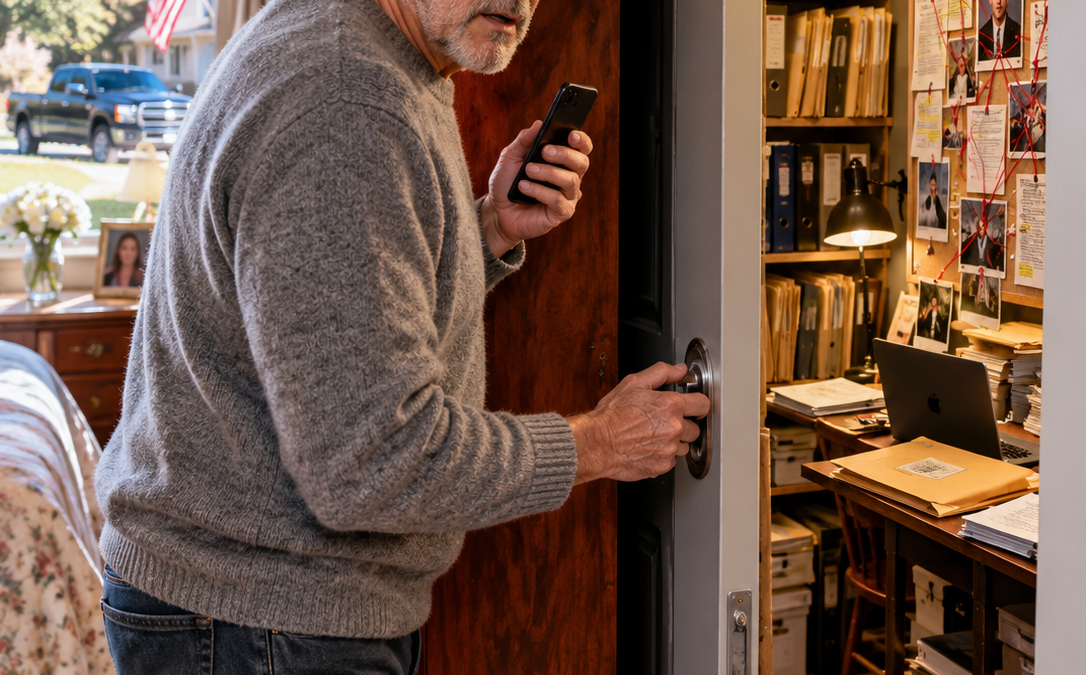
There was a door, low profile, painted the exact color of the surrounding wall with a flush mounted handle the size of a silver dollar tucked into the lower right corner.
I would not have found it in 10 years of looking if I had not known exactly where to look.
My phone rang.
It was my son.
Holden’s voice was tight in a way I had not heard since he was a teenager. And something had gone wrong that he needed to contain before I found out about it.
“Dad.”
His voice came out clipped and fast.
“Get outside right now. I’m pulling onto your street. Do not go into any of mom’s things until I get there.”
That last sentence moved through me cold and specific.
I looked out the window. His black truck was coming up the road.
I pressed the handle anyway.
The door swung inward on silent hinges. Cold air breathed out from the darkness on the other side carrying the smell of paper and cedar and something faintly metallic.
I found a light switch just inside the frame.
A single lamp clicked on.
The room was narrow, maybe 8 ft deep, 12 ft wide. Shelving on both side walls, a folding table along the far wall.
On the shelving, binders, manila folders, a corkboard leaning against the wall covered edge to edge in papers and photographs.
On the table, a laptop I had never seen before, a legal pad filled in Dolores’s handwriting, and an envelope with my name on the front.
Irving.
“If you found this, it means I ran out of time to tell you myself.”
The doorbell rang downstairs.
I stepped back out. I pushed the wardrobe as close to its original position as I could manage with shaking hands and went down to let my son in.
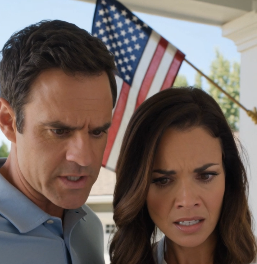
Holden was standing on the porch with two men I did not recognize. He put his arms around me and I let him, patting his back the way fathers do when they are holding themselves together by counting seconds.
When he stepped back, he introduced the men behind him.
The first was named Sinclair, older, silver-haired, carrying a briefcase that was meant to be noticed.
The second was a younger man named Puit, broad through the chest, who looked at the interior of my home the way you look at a room you are planning to come back to.
We sat at the kitchen table.
Sinclair opened his briefcase and arranged documents across the surface with the ease of a man who had done this many times before in living rooms exactly like this one.
He offered condolences about Dolores with a smoothness that told me he had never met her.
Then he explained why they were there.
Holden, he said, had been developing a venture called Malone Freight Solutions LLC, a logistic technology company built on the foundation of the Malone name and my 31 years of industry relationships.
There were formalities, time-sensitive filings.
He slid a document toward me.
I looked at the cover page.
My name appeared at the top.
Founding partner and senior principal, Irving Malone.
I had never heard of this company. I had never signed a single piece of paper connected to it.
I set the document down and looked at my son.
He met my eyes without blinking and said he had told me about it the previous spring, that I had been distracted with his mother’s treatment and had simply forgotten.
His voice was patient and reasonable and entirely constructed.
I recognized the construction. I had been watching it for 36 years without understanding what I was looking at.
I told them I would not be signing anything that day.
Sinclair began to explain about deadlines.
I told him that Dolores had been in the ground for 5 days.
He stopped.
Holden’s expression shifted under the surface into something cooler than I had ever seen there before.
Then he smiled.
The way a person smiles when they are managing a setback rather than responding to a father, and said they would give me time.
I watched them drive away.
Then I ran upstairs.
The room was exactly as I had left it. I moved the wardrobe the rest of the way, stepped through the door, and this time I did not rush.
The corkboard was covered in Dolores’s handwriting, notes pinned to photographs, to printed emails, to financial documents with sections highlighted in yellow.
Red string connected the pieces the way it does in detective shows, and the center of the board held my son’s name.
Holden Malone.
Written in red marker large enough to read from across the room.
Around it, bank statements, investor correspondence, LLC registration documents, and threaded through all of it in Dolores’s careful even script were notes I had to read slowly to believe.
“Holden registered the company without Irving’s knowledge. He has been presenting Irving as an active founding partner to investors. The signature on page four of the registration document is not Irving’s. I compared it to the documents he signed for the house refinancing in 2020. The pen pressure is similar, but the baseline angle is wrong.”
She had known.
I sat down at the folding table and opened the envelope she had left.
The letter inside was two pages, handwritten, the ink slightly uneven in the places where her hands had begun to fail her.
She told me she had first suspected something when she found LLC registration papers in Holden’s jacket while doing laundry two winters ago.
She said she had not come to me then because she was not certain and because she knew what I would have done.
“You would have called him,” she wrote. “You would have sat across the table from him and looked at him the way you look at people when you are trying to find the good thing in them. And if I was wrong, that conversation would have damaged something between you and your son that I wasn’t willing to risk on a suspicion.”
So she had been certain first.
12 months of being certain quietly while she was also dying.
I set the letter on the table and pressed my hands over my face and held them there until the sound I was making had finished making itself.
Then I picked the letter up and kept reading.
[Snorts]
She had hired a man named Benedict Marsh, a financial investigator out of Columbus 14 months ago.
She had built the room 9 years earlier when I was traveling for an extended run of contract negotiations using a contractor she had paid in cash and asked not to record the job.
She had not told me about the room because she had wanted a space that was entirely hers.
She had not told me about Benedict or the investigation because she had wanted to be certain before she handed me something that could not be taken back.
At the bottom of the letter, she had written a phone number, two initials beside it.
BM.
I found the prepaid phone she had left in the desk drawer. I plugged in the charging cable and waited.
While it charged, I worked through the binders on the shelves.
Each one was labeled in Dolores’s handwriting.
Corporate filings, investor communications, signature analysis, property records.
In the property records binder, I found a loan application Holden had submitted to a private lending group 8 months earlier.
In the asset section listed as collateral associated with founding partner Irving Malone was the lake property in Kosakton County that Dolores and I had sold 3 years ago.
A property we no longer owned listed as mine.
Dolores had clipped a note to the top with a red paperclip.
“I chose not to tell Holden when we sold the cabin. I wanted to see if he would use it anyway. He did. This is how we know for certain.”
She had set a trap.
She had baited it with our own property and she had waited while she was sick and frightened and making sure I could not see either of those things for him to step into it.
He had stepped into it.
The phone chimed on from across the room.
I picked it up.
One contact in the address book.
BM. A Columbus area code.
I pressed call.
The man who answered did not say hello.
He said quietly and without surprise, “Irving.”
His name was Benedict Marsh.
He told me Dolores had hired him 14 months ago. He told me she had described the phone and the room and said that if he ever received a call from that number, he would know who was on the other end and what it meant.
“Before I can tell you anything,” he said, “I need you to pull up your home security footage. The day of the funeral, starting around 10:00 in the morning.”
Our security system had four cameras.
I navigated to the front door feed and scrolled back to the date of Dolores’s service.
At 10:47 in the morning, I had been standing in the front pew at First Lutheran on Market Street, holding a folded program with her photograph on the cover, listening to the organ play, The Hymn She had requested.
At 10:47, a gray sedan pulled up to my house.
Puit got out.
He walked directly to my front door.
He entered a code into the keypad, a code I had not given him, and walked inside.
The time stamp ran forward.
At 11:09, he came back out.
He re-entered the code to lock the door.
He was carrying nothing.
He had been inside for 22 minutes during my wife’s funeral, looking for her files.
“Holden gave him the code,” Benedict said when I told him. “We believe it was transferred at least 3 weeks before the service when it became clear the timeline was accelerating. He sent someone into your home on the day you buried her to remove evidence he knew she had been collecting. He just didn’t know about the room.”
“He stood in my kitchen that morning,” I said. “Puit, with his hands folded on the table.”
“Yes,” Benedict said.
“That’s criminal trespass,” I said. “Under Ohio law, entering a structure without the owner’s consent. The code wasn’t given to him by me.”
“Yes, and there’s more.”
He paused.
“Irving, I don’t want to walk you through all of it over the phone. There are things in Dolores’s files that need to be seen in sequence. Can you meet with me tomorrow?”
He arrived the next morning at 9:00.
He was a compact, unhurried man in his late 60s with close-cut white hair and the steady eyes of someone who had spent a career delivering information that changed the shape of people’s lives and had learned to do it carefully.
When I led him upstairs and threw the panel into Dolores’s room, he stopped in the doorway and looked at the corkboard for a long moment without speaking.
“She finished this board about 6 weeks before she passed,” he said. “The last time I was here, she was still adding to the right side.”
He cleared his throat.
“She did exceptional work.”
“I know,” I said.
[Snorts]
He set his satchel on the folding table and removed a small digital recorder.
He told me Dolores had made recordings, three of them.
She had kept the recorder in her apron pocket during two conversations in this house and had captured a third by phone.
The first was from 11 months ago.
Holden had come for Sunday dinner and Sinclair had called him in the middle of the meal.
Dolores had stayed in the kitchen and had not left the room.
Benedict pressed play.
The audio was imperfect. The ambient sounds of a kitchen underneath two voices, but the words were clear.
Sinclair’s voice first, smooth and professional.
“The senior partner documentation has to be in place before we go to the Midwest group. We can’t walk into that meeting with unsigned certifications. It creates questions we don’t want raised.”
Then Holden’s voice, familiar and entirely strange at the same time. The way something looks wrong when you stare at it too long.
“He’ll sign. I just need the right window. Right now, he’s focused on mom. Once she’s gone, he’ll be off balance. That’s when we move.”
A pause on the recording.
Then Sinclair again.
“And the mother. Is she aware of any of this?”
Holden’s voice, flat and almost dismissive.
“She doesn’t understand the business side of things. She’s not going to be a problem.”
Benedict stopped the recording.
The room was very quiet.
My wife had been in the kitchen 12 ft away when our son said those words.
She had been standing at the counter in her apron with her recorder in her pocket and she had not moved and she had not left the room and she had written in her notes later.
“He was wrong about me. I need him to keep believing he was right.”
I pressed my palms flat against the table and held them there until the shaking stopped enough to be manageable.
“She built this room,” I said finally. “She spent 12 months filling it. She set the trap with the cabin. She stayed in that kitchen and let him underestimate her. And he sat there and told that man that she wasn’t smart enough to cause trouble.”
“Yes,” Benedict said again.
He did not offer comfort.
I was grateful for it.
We played the other recordings.
In the second, Holden had arranged for Puit to enter the house on the day of the funeral.
The full conversation captured on a call Dolores had recorded three weeks before she died, sitting in the sun room with her phone face down on the table beside her, and Holden across from her talking to Puit on speaker, not asking her to leave, not lowering his voice because he had believed she was not paying attention.
She had written in the margin of her notes, “He has always underestimated quiet women.”
In the third recording, Holden and Sinclair were reviewing an investor presentation and used my name 11 times in 9 minutes.
Each time, my professional history was cited.
The years at Malone Freight Partners, the contracts we had held with major manufacturers across the Midwest, the relationships I had built over three decades, presented as an active endorsement of a company I had never joined.
“He’s not borrowing your name.”
Dolores had written in the center of the corkboard directly below Holden’s name in larger letters than anything else on the board.
“He’s wearing it, and when the weight of what he’s built becomes too heavy, the people he owes will come looking for the man whose name is on the paperwork.”
I stood up and walked the three steps to the far wall and put both hands flat against the plaster, and stood there with my arms straight and my head down, breathing.
Benedict waited.
After a while, I went back to the table.
I asked him who I needed to call.
“Clawudet Osi,” he said. “Dolores left her name in a separate envelope in the desk drawer. She said you had used her for the business sale and that you trusted her completely.”
He paused.
“She said that if this ever went where she thought it was going, Claudet Osi was the person you needed.”
Clawudet arrived the following morning with a legal pad and an associate who moved efficiently and spoke only when asked.
She looked at Dolores’s corkboard the way Benedict had looked at it, with a long, careful assessment that took in everything at once.
“Your wife was meticulous,” she said.
“Yes,” I said. “She was the most careful person I have ever known.”
Cludet spent 2 hours going through the files.
When she finished, she sat down across from me at the folding table and looked at me directly over the top of her reading glasses.
“Wire fraud,” she said. “The use of electronic communications to execute a scheme to defraud. Every email in which Holden represented you as an active consenting partner in Malone Freight Solutions is a potential separate count. Our preliminary review shows 34 such communications.”
She let that settle.
“Forgy under Ohio Revised Code section 291331. Six confirmed instances of your signature on documents you did not sign. Identity fraud and criminal trespass. The entry by Puit on the day of the funeral captured on your security system using an access code provided by Holden without your knowledge or consent.”
I looked at the corkboard at Dolores’s handwriting surrounding everything, holding it together.
“What are my options?” I asked.
Cladette set her glasses on the table.
“We go to the investors first,” she said. “Before we contact the FBI, I want Holden to sit in a room and watch the foundation of everything he has built come apart in front of witnesses. I want every person who was shown a document with your forged signature to hear from you directly that you never signed it. Then we take the full package to federal authorities with a case we built ourselves.”
She looked at me steadily.
“I need you to call Holden. Give him a reason to arrange a meeting that includes the investors and includes you. Make him think you’ve reconsidered.”
“I can do that,” I said.
He called me that evening.
He had been calling every few hours since the morning I turned them away.
I let it go to voicemail twice before I answered on the 3.
I told him I had been thinking, that I had been too reactive the day he came, that I wanted to understand the company properly, sit with the investors, ask my questions.
His voice expanded with a warmth that I now understood as a performance he had been refining for years.
He said he would set up the meeting for Friday.
After I hung up, Benedict told me he had placed a motions activated camera in the upper corner of Dolores’s room covering the full table and the document he had left there, a fabricated memo created by Clawudet describing a meeting in which Irving Malone would bring original documentation to present to investors.
It was placed at the front edge of the table, slightly angled toward the door.
Bait, simple and specific, designed for a man who had already proven he would walk into rooms he had no right to enter.
He came Thursday morning wearing casual clothes, jeans, a flannel shirt, the costume of a son, stopping by to check on his father.
He sat at my kitchen table and drank coffee and talked about the weather and asked whether I had been eating.
He was good at it.
He had always been good at it.
Then he said he thought he had left his phone charger in the upstairs bedroom and asked if he could run up.
I told him to go ahead.
I sat at the kitchen table and listened.
After a moment, the low scrape of the wardrobe moving across the hardwood floor.
He came back down 4 minutes later holding a charger.
We both knew he had walked in without one.
“I’ll see you Friday,” he said.
He rinsed his coffee cup in the sink. I had taught him to do that when he was 8.
And walked out.
Benedict’s text arrived 3 minutes after the truck left the driveway.
“Camera got everything. Six photographs of the document. Clear footage.”
Then a second message.
“He left a listening device under the table. Small. Leave it.”
I texted back two words.
“Leave it.”
If Holden wanted to listen, I would give him something worth hearing.
Between now and Friday, every word out of my mouth in that room would be exactly what he needed to believe, right up until the moment it wasn’t.
Friday morning I wore the navy blazer Dolores had picked out four years ago at a department store in Akran.
She had steered me away from the brown one I had reached for and held the navy up against my shoulders with the quiet authority of a woman who had been dressing her husband correctly for decades.
She had said, “That one,” and that had been the end of it.
I had worn it to the closing of the business sale.
I wore it now because it was the jacket I wore when things mattered.
This morning things mattered.
Benedict drove.
Clawdet met us in the building lobby and went ahead to the conference room adjacent to the investor’s suite while I took the elevator up alone.
I watched Holden through the narrow window beside the conference room door before I walked in.
He was at the head of the table, relaxed, one hand moving through a practice gesture as he spoke to the four people arranged along the sides.
Sinclair was to his left, Puit at the far end.
I opened the door.
The room shifted around my entrance.
Heads turned.
Sinclair’s pen stopped.
Puit’s jaw tightened.
Holden’s face went through three expressions in the span of a second.
Surprise, recalculation, and finally the warm and practiced smile settling over the first two like a curtain being drawn.
“Dad.”
He stood.
“I thought we said 9:30.”
“It’s 9:30,” I said.
I walked to the open chair at the opposite end of the table and sat down and folded my hands and looked at Sinclair.
“Please,” I said. “Continue.”
Sinclair recovered with professional speed and picked up where he had been when I walked in.
He spoke about Malone Freight Solutions as an extension of my 31-year legacy, about the market positioning, about the credibility my senior partnership brought to the venture.
He cited my professional history twice.
He said the investors were fortunate to have an opportunity anchored in genuine industry expertise.
He said Irving Malone’s name was synonymous with freight integrity throughout the Midwest.
I let him finish.
Then I reached into my briefcase and placed a small digital recorder on the table.
Holden’s eyes went to it.
His jaw did not move.
Something moved behind his eyes that I recognized from 36 years ago when he was seven and had broken the neighbor’s fence with his bicycle.
And I had walked out holding the evidence and looked at him and he had understood before I said a word that there was no version of the next few minutes that ended the way he wanted.
“I have one question,” I said.
I looked at Sinclair.
“When exactly did I agree to join this company?”
Sinclair opened his mouth, closed it.
The hesitation lasted less than a second, but I had been watching him carefully for the past 8 minutes, and I did not miss it.
Holden spoke before he could recover.
“Dad, we talked about this. You said you wanted to be involved in whatever I built next. You may be misremembering because of everything with mom.”
“I don’t misremember,” I said. “That has never been one of my problems.”
I removed the first document from my briefcase, a copy of the founding partner certification with my forged signature on page five.
I slid it down the center of the table so the investors could see it.
“What signature is on that document?” I asked.
One of the investors, a woman Holden had introduced as Dr. Vasquez, who led a regional investment group, leaned forward and studied it.
“Yours,” she said.
“It isn’t,” I said. “I’ve never seen that document until 6 days ago.”
I removed the second sheet.
“This is a notorized sample of my actual signature from the 2021 sale of Malone Freight Partners. I’d like you to compare the two.”
The room leaned in.
Even Puit shifted forward by a fraction.
I removed the third document, the loan application listing the Koshakton County property.
“This lake cabin,” I said, “was submitted to a private lender 8 months ago as an asset associated with my name. My wife and I sold it 3 years ago. It belongs to another family. If I were genuinely a founding partner with active knowledge of this company’s filings, how did a property I no longer own end up in a document submitted under my name?”
No one answered.
Dr. Vasquez set her copy of the investor packet down.
The man beside her pushed his chair back slightly from the table.
I reached forward and pressed play on the recorder.
Holden’s voice filled the conference room, clear and unhurried.
“He’ll sign. I just need the right window. Right now he’s focused on mom. Once she’s gone, he’ll be off balance. That’s when we move.”
Sinclair’s voice on the recording.
“And the mother, is she aware?”
Holden’s voice.
“She doesn’t understand the business side of things. She’s not going to be a problem.”
I stopped the recording.
The door across the hall opened.
Claudet Oce walked in.
She moved without rushing, set document packets in front of the investors, and introduced herself as my attorney of record.
She spoke without raising her voice.
She described 34 counts of wire fraud under federal statute.
She described forgery under Ohio law.
Six confirmed instances.
Identity fraud.
Criminal trespass on the day of Dolores Malone’s funeral captured on security footage committed by a man who had been sitting at the far end of this table for the past hour.
Every head in the room turned toward Puit.
He looked at the table in front of him.
Then he stood, said he needed to make a call, and walked out without looking at Holden.
The investors collected their things within 90 seconds of each other.
Dr. Vasquez looked at Holden with an expression from which all warmth had been removed and said she expected to receive formal notification from her own attorneys before end of day.
Sinclair was last.
He picked up his briefcase and looked at Holden with something that was mostly self-preservation.
Wearing the mask of regret, he said he couldn’t be part of this.
He walked out.
The door swung shut.
The room was empty except for the three of us.
Holden stood at the head of the table with his hands flat on the surface and his chest rising and falling with a breath that shook on the way out.
He looked at me.
“She told you everything,” he said.
His voice was barely above a murmur.
“She told me enough,” I said. “She told me what she knew, which was more than you gave her credit for.”
Claudette spoke quietly.
“Formal notification letters will go to all parties within 24 hours. The evidentiary materials will be submitted to the FBI field office in Cleveland by end of business Monday. Wire fraud at this scale falls under federal jurisdiction.”
She closed her portfolio.
“My client did not create this situation.”
Holden looked at me across the empty table.
“Dad.”
His voice had come undone somewhere in the middle of the word.
Not breaking exactly.
Something more like fraying the way a rope frays under tension before it gives.
“I know what I did,” he said. “I need you to know that I knew it the whole time. I told myself it was temporary, that I was going to bring you in for real once the company had a foundation, that I was going to make it right.”
He pressed a fist against his mouth.
“I told myself that story for 2 years.”
I looked at my son, at the face I had watched change from an infant’s to a boy’s to a man’s over 36 years.
“You sat in our kitchen,” I said. “You told Sinclair your mother wasn’t smart enough to cause you trouble. She spent the last 14 months of her life building the room that just took everything apart. And she did it while she was frightened and sick and making sure I didn’t see either of those things. She did all of that and you sat at her kitchen table and told a stranger she wasn’t going to be a problem.”
His shoulders shook once hard.
“I’m sorry,” he said. “Dad, I’m so sorry.”
“I know you are,” I said. “You’re sorry because it didn’t work. Whether you’re sorry for anything else, that’s something you’re going to have to figure out on your own.”
I walked to the door.
I stopped with my hand on the frame.
“She loved you,” I said without turning around. “Even at the end, knowing what she knew. She loved you. I don’t entirely understand that, but I knew her better than I’ve ever known anyone. And she was not a woman who did things she didn’t mean.”
I walked out.
The elevator was waiting.
I stepped inside and pressed the lobby button and watched the doors close and stood in the mirrored box alone in Dolores’s navy blazer, looking at the man she had chosen to protect.
He came to the house that evening at 7:00.
I saw the headlights from the kitchen window and set my soup spoon down and waited.
Three quiet knocks on the front door.
Nothing like his usual knock.
“Dad.”
His voice came through the wood, muffled and careful.
“I know you’re home. I saw the kitchen light.”
I walked to the door.
I put my hand flat against it.
“I’m not here to argue,” he said. “I’m not here to ask you to undo anything. I know the process is going to move forward. I just need to say some things.”
He said he had known the whole time what he was doing was wrong.
He said he had told himself the story about making it right until the story became easier to believe than the truth.
He said he was going to retain an attorney.
He was not going to fight the process and that he was going to spend whatever time he had before it resolved trying to understand how he had become a person capable of this.
He said he wasn’t asking for anything.
I stood with my forehead pressed against the cool wood of the door and thought about the last letter Dolores had left me.
I found it tucked inside the wedding photograph she had pinned at the center of the corkboard.
The photo from September of 1986.
The two of us laughing outside the church in the afternoon light.
The letter was small, written late, the handwriting more uneven than the others.
She had still made every word legible.
She had still made every sentence exactly what she meant it to be.
“What Holden did has a name,” she had written, “and the law will name it. What you are about to do also has a name. It’s called keeping your word. You promised me 38 years ago that you would be the kind of man who showed up when it counted. I want you to know that you showed up every single time.
“I am not asking you to forgive him today or tomorrow or on any particular schedule. I am asking you not to close the door so completely that neither of you can ever find your way back through it. That is all. You get to decide everything else.”
I stood with my forehead against the cool wood and held all of that.
“I heard you,” I said through the door.
A long silence.
“I’m not opening it tonight,” I said. “I need you to understand that and I need you to go. Not because I’ve decided anything, because I can’t think clearly with you standing on the other side of this door.”
“Okay,” he said.
The word came out small.
I heard him go down the porch steps.
I heard his truck start and back down the driveway and fade onto the street until there was nothing left but the sound of the October wind moving through the oak tree in the sideyard.
I stood in the hallway for a long time, holding the spare key I had taken off the hook beside the door, the one I had given him years ago when he moved into his first apartment, brass, worn smooth from years of use.
I held it in my palm and thought about the letter.
Then I walked upstairs and put it in the lock box in Dolores’s room next to the USB drive and the property deed and the contractor invoice from the year she had built the room, and I closed the lid.
Then I went back to the bedroom and sat down on her side of the bed for the first time since she died.
The hollow was still there in the mattress, pressed in by 38 years of her.
I put my hand on her pillow and felt the cool cotton under my palm.
And the gardinia smell was still faintly there, fainter every day.
I knew that.
And I let myself know it fully rather than flinching from it because that was something she had tried to teach me for years.
And I thought maybe I was finally getting it right.
I reached over to the nightstand and took out her last letter.
I knew every line of it by now, but I unfolded it in the low lamplight and read it again.
Anyway, the final paragraph was short, written in a hand more uneven than the rest, the letters slightly tilted where her strength had been giving out.
“I built the room because I needed somewhere to put the truth until you were ready for it. I filled it because I needed you to be able to see everything at once so that no single piece of it could be explained away. I am leaving it for you because I trust you to know what to do with it. You have always known what to do, Irving. Even when you thought you didn’t, that has never changed. I love you. I am sorry I couldn’t stay longer to see how this turns out.
“One last thing, go eat something. The soup on the stove is not going to heat itself.”
I laughed.
The wet, undignified kind that comes out of a person when they are crying and trying not to be.
I pressed the letter against my chest and sat with it until the feeling settled into something I could carry.
Then I went downstairs, heated the soup, and ate every last bit of it.
She had asked me to.
That was enough.
If you came here from Facebook because of this story, go back to the Facebook post, hit Like, and comment exactly “Heartfelt.” That small action means more than you might think. It supports the storyteller and gives the writer extra motivation to keep bringing you more stories like this. Thank you for taking a moment to support the story.