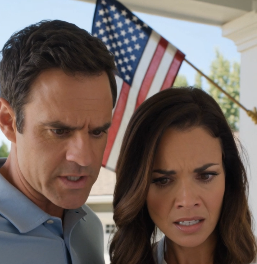
My daughter’s groom dumped champagne on my head in front of 200 guests. I didn’t flinch. I just walked calmly to the mic to reveal his secret… He begged me to stop.
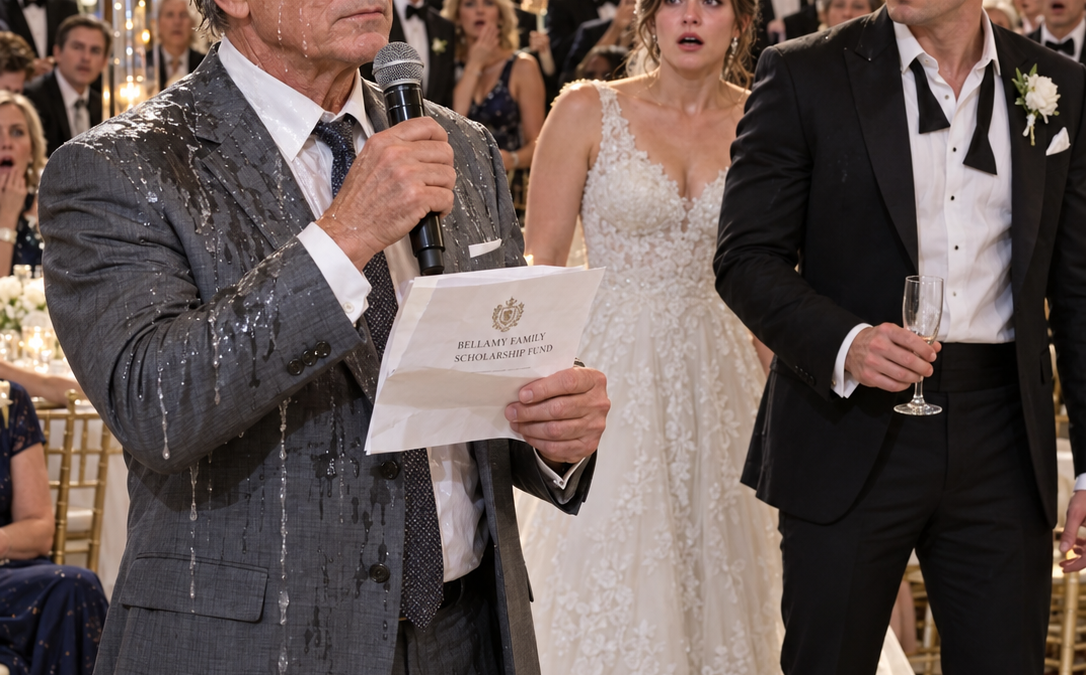
The champagne hit the top of my head at exactly 7:43 in the evening.
I know the time because I just checked my watch, wondering if I could slip out quietly after the first dance without Jenna noticing.
My daughter always noticed everything.
What I didn’t know, standing there with sparkling wine running down my nose and soaking into my collar, was that my new son-in-law had just made the biggest mistake of his life.
And every cent of that mistake had come from my late wife’s insurance money.
Let me back up to the beginning.
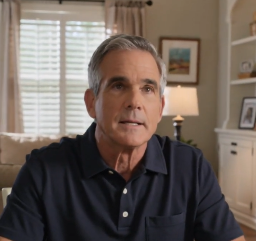
My name is Fred Bellamy. I’m 63 years old.
For 31 years, I ran Bellamy Electrical Contracting out of a shop on Milbrook Road in Raleigh.
Started with two trucks and four guys.
By the time I sold the company in 2021, we had 47 employees, a regional contract with three hospital networks, and a reputation I’d built one honest job at a time.
The buyer paid me $1.4 million for it.
I drove home in my 2016 Ford F-150 with 127,000 mi on it and stopped at the Hardies on Glenwood Avenue because I hadn’t eaten since breakfast.
That’s who I am.
That’s who I’ve always been.
My wife Alice was the other half of that.
She taught third grade at Brentwood Elementary for 22 years. The kind of teacher whose former students bring their own children back to meet her.
She died of ovarian cancer 18 months after her diagnosis on a Thursday morning in February, with my hand in hers and the window blind striped with early light.
She was 59 years old.
The room number was 227.
I remember every detail of that room because I sat in it for 71 days.
One of the people who made those 71 days bearable was a young man who worked the pharmacy counter on the second floor.
His name was Colby Marsh.
He was 24 then, working as a pharmacy technician while he studied for his dental school admissions exam.
Every time Alice needed a medication adjustment, and there were many, Colby was the one who came up to the room to explain the changes instead of just sending a nurse.
He drew pictures to help her understand how the compounds worked because Alice always said she understood things better when she could see them.
He learned her first name and used it.
When I fell asleep in the chair beside her bed and woke up at midnight stiff and disoriented, Colby was sometimes still there doing rounds, and he’d quietly pull a second blanket from the closet and set it across my lap without saying a word.
That kind of thing doesn’t leave you.
When Alice died, she left behind a $385,000 life insurance policy.
Money we’d set aside over 30 years.
Money meant to carry me through whatever came next.
I sat with it for 6 months trying to figure out what Alice would want me to do with it.
She had no patience for anything wasteful or showy.
She believed in putting resources where they could grow something real.
I established the Alice Bellamy Memorial Scholarship through First Carolina Trust Bank, administered anonymously.
The purpose: to fund the graduate education of students in healthc care fields who demonstrated both academic excellence and genuine compassion in patient care.
I listed three selection criteria: academic performance, financial need, and something I called the service record.
Documented evidence of how the applicant treated people who couldn’t do anything for them in return.
Kobby Marsh was the fund’s first recipient.
His dental school application included a recommendation from the paliotative care supervisor at the hospital describing a pharmacy tech who memorized the names of terminally ill patients family members and treated them all like they mattered.
I recognized the description before I even saw the name.
He never knew who funded his education.
That was the point.
He didn’t know when the first dispersement check arrived from First Carolina Trust.
He didn’t know when he made the deans list twice in a row.
He didn’t know when my daughter Jenna, who worked in hospital administration at the same Raleigh Medical Center, met him at a fundraiser two years later and called me on a Sunday to say she’d met someone.
He certainly didn’t know on the evening of May 10th when I pulled my F-150 into the valet lane at Pine Brook Country Club and handed over my keys to a young man in a red vest.
The valet tried not to look at the truck.
He mostly succeeded.
Inside, the pine brook was doing what the pinebrook always does, making sure you understood you’d arrived somewhere important.
Chandeliers that probably cost more than Alice’s entire first classroom.
Floral arrangements taller than I am.
Weight staff moving like they’d been choreographed.
Jenna had shown me the venue contract, $18,000.
She’d been worried about it.
I told her not to worry, which was true.
What I didn’t mention was that I could have written that check before lunch without blinking.
Jenna knew I’d sold the company, but not what the number actually was.
She’d grown up watching me clip grocery coupons and buy my shirts at Belk’s clearance rack, so her mental picture of comfortable didn’t quite match reality.
Alice and I had always believed money was a tool, not an identity.
We saw no reason to advertise the toolbox.
Col’s family was from outside Asheville.
His father, Noel Marsh, ran a small landscaping crew.
Good man, firm handshake, clearly a little nervous in the country club environment.
We sat together during cocktail hour and talked about the drive up, talked about football, talked about everything except the fact that we were both quietly aware that our children had entered a world where men like us were considered scenery.
Col’s dental school friends arrived in a cluster.
Four of them, young men in suits that fit too well with the easy confidence of people who had never once wondered about the bill.
I heard one of them, a tall fellow with a reddish beard named Stafford Keel, according to the program, say to the man beside him, just loud enough to carry, that Jenna’s dad had driven a work truck to the reception.
The other one pressed his lips together in that particular way people do when they’re pretending not to find something funny.
I kept my face neutral and refilled my glass of ice water.
Colby came over during the salad course, a little looser than he’d been at the ceremony.
He’d been drinking steadily since the cocktail hour.
That’s the kind of thing you notice when you’ve spent 30 years watching employees on job sites, learning to read who’s managing themselves and who isn’t.
“Fred.”
He settled into the chair beside me, his arm going around my shoulder in that way that feels like friendliness but carries weight.
“Everything going okay over here?”
“Everything’s fine.”
“Good. Good.”
He looked around the table.
Noel, a couple of Jenna’s co-workers, my neighbor Harriet, who’d known our family for 20 years.
His smile stayed fixed.
“Listen, some of my colleagues were asking about you, your background.”
“Asking what?”
He picked up a dinner roll.
“Just what you did for work. I told them you had a contracting business.”
He said it like that.
A contracting business.
The same tone you’d use for something like he grew tomatoes in the backyard.
“I retired from that.”
“Right. Right.”
He broke the role in half.
“Anyway, I kept it simple.”
I didn’t ask what that meant.
I already knew.
The best man’s toast came around 8:00.
Stafford Keel had the practice timing of someone who’d been asked to speak at weddings before.
He talked about K’s brilliance, his ambition, his trajectory.
He mentioned a partnership track at a prominent rally practice that Stafford’s uncle happened to own.
Then he said, “We all know Colby could have had his pick. He chose Jenna because she’s exactly the kind of woman who will support the life he’s building.”
Not the life they’d be building together.
The life he was building, and she would support it.
I looked at Jenna.
She was smiling, but it was the smile she used when she was working something through.
I’d seen that smile at Alice’s bedside.
She was filing it away.
The dancing started.
Jenna found me and pulled me to the floor for the father-daughter song, Unforgettable, which had been Alice’s favorite.
We swayed together, and Jenna pressed her forehead to mine the way she used to when she was small and overwhelmed.
“Is everything okay, Dad?”
“Your mother would have cried through the entire ceremony,” I said.
She smiled genuinely then.
“She would have lectured Kobe’s friends about flossing.”
We both laughed.
It was the realest moment of the evening.
Then Colby cut in, and Jenna went with him, and I stepped back toward the edge of the floor.
That’s when Stafford materialized beside me with a fresh glass of bourbon and the particular confidence that comes from never having been told no by anyone who mattered.
“So Fred, what exactly did you do before you retired?”
“Electrical contracting. Residential, commercial, mostly hospital systems, industrial facilities, some municipal work.”
He nodded slowly.
“My old man’s an anesthesiologist. Col’s going to do well for himself. Good earning potential. He’ll be able to take good care of Jenna.”
“Jenna takes care of herself,” I said evenly.
“Sure, sure. I just mean the lifestyle adjustment, country club, the right circles. It’s good that Colby has that kind of trajectory.”
I kept my face pleasant.
“What kind of trajectory do you think I’ve had?”
He blinked.
“Oh, I just mean—”
“I know what you mean.”
Colby had drifted back during this exchange.
His bow tie was loose.
He looked between Stafford and me, and something shifted behind his eyes.
That calculation I’d been watching all evening.
You’re a complication I need to manage.
“Glad to see you two getting acquainted,” he said, clapping my shoulder.
He paused on me a beat too long.
“Fred, I told the guys you were a contractor before you retired. Salt of the earth.”
Salt of the earth.
That was the third time tonight.
I set down my glass.
“Colby,” I said, “I want to ask you something. How did you pay for dental school?”
He laughed, the surprised laugh of someone caught off guard.
“Scholarship mostly. Why?”
“Which scholarship?”
He waved his hand.
“First Carolina Trust administered it. Anonymous donor. It’s not really dinner conversation.”
Stafford cut in helpfully.
“Kobe’s grades basically covered everything. Top of his class on the admissions.”
I reached into the inside breast pocket of my suit jacket.
Not a briefcase, just my jacket where I’d folded a single document that morning before I left the house.
I’d been carrying it all day, not knowing if I’d need it, hoping I wouldn’t.
Before I could open it, Col’s eyes went to my hand, and something in the deliberateness of the motion seemed to crack whatever thin patience he had left.
The bourbon, the long evening, the audience of Stafford and two other colleagues who drifted close.
I watched it all compound in real time.
“What is that?”
His voice had an edge now.
“Something I brought in case it was relevant.”
“In case it was relevant?”
His voice climbed.
“Fred, this is my wedding night. What could you possibly have in your jacket pocket that’s relevant right now?”
He looked at the small circle that had formed around us.
“I’ve been patient all evening. You show up in a work truck, sit in the corner, and now you’re pulling documents out at my reception. Like—”
He laughed short and hard.
“Like you have something to prove.”
“I’m not trying to prove anything.”
“Right?”
He reached past me and lifted a champagne flute from the tray of a passing server, the expensive kind, reserved for toasts.
“Because here’s the thing, Fred.”
His voice had gone somewhere past drunk now, somewhere that had been building since the cocktail hour.
“This is Mowit. $45 a glass. This reception cost more than most people earn in three months. And I worked for this. I earned this.”
He looked at me with something that had been underneath the shoulder clapping and the salt of the earth all evening.
Finally surfaced.
“You come in here in your off the rack suit, in your old truck, and you’re going to stand at my reception and pull papers out of your pocket.”
“Put the glass down.”
“Don’t call me son.”
He wasn’t listening to anything anymore.
“You’re Jenna’s father. That’s it. That’s where this starts and ends. And people like you.”
He upended the champagne glass over my head.
The moment was cold, perfectly chilled, the way they keep it in the back before a toast.
It ran through my hair and down the back of my collar and dripped off the edge of my jaw.
The circle of guests around us went silent first.
Then the silence spread outward like a stone dropped in still water, moving table by table across the ballroom until the band stopped playing, and every one of those 200 people had turned to look.
Ke stood there with the empty flute in his hand.
“You don’t belong up here,” he said, quieter now, but somehow carrying to every corner of the room. “You never did.”
I heard Jenna’s voice from somewhere behind me.
Just the one word.
“Dad.”
In a tone I will never unhear.
I didn’t raise my voice.
I didn’t reach for him.
I stood still for a moment with Moette dripping off my nose.
And then I turned and walked calmly toward the bandand.
The band leader, a man in his 50s, the weathered face of someone who had witnessed everything that could happen at a wedding, watched me approach.
I held out my hand.
He looked at me for a moment.
Then he placed the microphone in it without a word.
I turned to face the room.
200 people.
Complete silence except for the sound of someone near the back carefully setting down a glass.
“My name is Fred Bellamy.”
I said it evenly.
“Most of you know me as Jenna’s father. Some of you know me as the man with the work truck in the valet lane. I’d like to tell you something else.”
I unfolded the document from my jacket pocket.
“This is a scholarship agreement issued through First Carolina Trust Bank dated September 4th, 4 years ago. The fund is called the Alice Bellamy Memorial Healthcare Scholarship.”
My wife Alice died of ovarian cancer.
She was 59.
“This fund was established using her life insurance payout, $385,000. Because Alice believed the best thing you could do with resources was grow something useful with them.”
I held up the document so the room could see it.
“Over the past four years, this scholarship has dispersed $38,400 in tuition, fees, and educational expenses to its primary recipient. His name is on the first page.”
The silence had become something you could feel.
“Colobby Thomas Marsh.”
There was a sound from the crowd, a sharp intake of breath, a stifled word.
I heard Jenna say something I couldn’t make out.
“Colby,” I continued, “you were a pharmacy technician at Rex Hospital when my wife was dying in room 227. You drew pictures to help her understand her medications. You learned our names. When I fell asleep in the chair beside her bed, you put a blanket over me without waking me up. I watched you do that. You didn’t know anyone was watching.”
My voice stayed level.
I’d had four years to think about this moment, even though I’d prayed I’d never have to use it.
“That is why I funded your education, not because you were brilliant, though the records confirm you are. Because you treated a dying woman and her exhausted husband like we were worth something. And I believed a person who made that choice instinctively was someone who deserved a chance to make it a thousand more times in an exam room over a whole career.”
I looked at him.
Colby was standing very still.
The empty champagne flute was still in his hand.
His face had gone a color I’d never seen on a living person before.
“You’ve called me salt of the earth three times tonight,” I said. “By the third time, we both understood what you meant by it.”
I folded the document and returned it to my jacket pocket.
“But here’s what I know about salt. It doesn’t change what it is based on who’s looking at it. And it does its work whether anyone notices or not.”
I handed the microphone back to the band leader.
He gave me one small nod.
I walked back toward my table.
The room held its silence for a long moment.
Then I heard Jenna’s heels on the marble.
Fast, deliberate.
She walked past her husband without pausing.
She walked straight to me and put both arms around my neck the way she had when she was 7 years old and didn’t know how else to handle something too large for her.
And she held on.
“I’ve got you,” I told her. “I’ve got you.”
Behind us, Colby found his voice.
“Jenna, I—”
“Not right now.”
She said it clearly without turning.
Nolar should come to stand beside us.
He put his hand on my arm.
“Fred, I didn’t know. I had no idea.”
He His voice cracked clean through.
“I’m sorry.”
“This isn’t yours to carry, Noel.”
Stafford Keel had disappeared.
I noticed that the cluster of dental school friends had redistributed themselves to the outer edges of the room with the particular invisibility of people who want no association with what just happened.
By midnight, Jenna and Colby had left separately.
Monday morning, my phone rang four times.
The first call was from Anton Webb at First Carolina Trust, who administered the scholarship.
He’d seen something on social media.
One of the guests had filmed the microphone moment and it had traveled considerably further than any of us had planned for the character clause.
I told him Alice wrote those terms herself.
She’d read the draft and added three words: demonstrated and documented.
Anton said he understood.
The second call was from Janet Puit, who had been my project manager at Bellamy Electrical for 14 years before I sold the company and who now lived in the same neighborhood as the country club.
It turned out she’d been a guest at a table near the back.
She told me she had stood up when the champagne came down and had to be talked out of crossing the room by her husband.
“You should have let him try,” I said.
She laughed the way she always laughed without any effort.
“Fred, you handled it better than any of us could have.”
I didn’t feel like I’d handled anything.
I’d stood in a country club ballroom with expensive wine dripping off my face and given a speech while my suit dried, but I hadn’t burned anything down that couldn’t eventually be rebuilt.
The third call was from Jenna.
She talked for a long time about things she’d been filing away for 8 months.
The way Colby sometimes corrected how she spoke in front of his colleagues.
The comment at Christmas about her career not complimenting the life he was building.
The pattern she’d explained away because she loved him and because she didn’t want to confirm what she was starting to see.
“I should have talked to you sooner,” she said.
“You were protecting something you believed in. That’s not a fault.”
She was quiet for a moment.
“Mom would have figured it out faster.”
“Probably,” I agreed. “She was always sharper than both of us.”
The fourth call was from Colby.
He called the next morning, and his voice had been scraped clean of every smooth surface it had carried the night before.
He didn’t make excuses.
He said he’d gone to see his father that morning, that Noel had said things to him he needed to hear, and that he’d sat with them for a long time without being able to answer.
“I remember your wife,” Colby said. “I remember she called me by name every time, even when she was exhausted. I remember you thanking me for things I thought were just basic decency.”
He paused.
“I don’t know when I started thinking basic decency was the ceiling instead of the floor.”
I didn’t respond right away.
I let it sit.
“The scholarship is concluded,” I said finally. “That decision is made, but the education is yours. What you do with it still belongs to you.”
He said he understood.
What I didn’t tell him, because it wasn’t that moment, was that the Alice Bellamy Memorial Healthcare Scholarship currently supported four other recipients.
A second-year nursing student from Rocky Mount who was supporting her mother and two younger siblings.
A firstear dental hygiene student from Fagatville whose family had never had a single person work in medicine.
A pharmacy student who ran a free medication pickup service for elderly neighbors on weekends.
And a young man studying to become a physician assistant who organized a monthly transportation network for patients who couldn’t reach their own appointments.
Alice had written the criteria that chose them.
I just kept the account funded.
6 months after the wedding, Jenna told me over dinner that she’d filed for separation.
She said it the way she handled most things, directly and without drama about the fact of it.
“How are you doing?” I asked her.
She considered it genuinely.
“Like I didn’t lose something I had. Like I found out what something actually was before I went any further down that road.”
That sounded like her mother.
Colby, from what Noel told me over time, was working, still finishing his residency, managing the practical consequences of a character clause termination from an anonymous scholarship fund, which turned out in the dental school community to be the kind of story that got around without anyone needing to announce it.
Not the end of a career, but a recalibration.
Noel mentioned that Colby had started volunteering Sunday mornings at a free dental clinic in Asheville.
I didn’t know what to do with that information except hold it and wait and see.
I drove home from Jenna’s apartment late on a Tuesday evening in October down I40 in my F-150 with the windows open and the radio finding an old country station through the static.
It was warm for the season.
The median trees still had most of their leaves.
I thought about room 227, about the way Alice looked at Colby when he explained something to her with that particular attention she gave to people who were making an effort to be clear.
She’d said to me once after he’d stepped out into the hallway, “He’s going to be a good one. You can tell.”
She was almost always right about people.
I thought she’d be right about him eventually, given sufficient time and sufficient consequence.
But Alice also would have told you in that direct way she had that time doesn’t owe patience to people who haven’t earned it yet.
The scholarship reports come to me quarterly through Anton at First Carolina Trust.
I read them at the kitchen table with my coffee, the same way Alice used to read her students writing assignments.
Not just for what was there, but for what was underneath, for the evidence of a person trying to become someone better than where they started.
Last fall, I attended the pinning ceremony for our nursing scholarship recipient when she completed her degree.
She didn’t know who I was.
I sat in the back in my Belulks clearance rack button-down and watched her walk across the stage.
She looked exactly like someone who was going to take good care of people.
Alice would have stood up and cheered.
I stayed in my seat, but I clapped until my hands were sore, and I didn’t stop until they called the next name.
Sometimes the whole point is not to be seen.
If you came here from Facebook because this story stayed with you, go back to the Facebook post, tap Like, and leave exactly “Great read” in the comments. That small action means more than you might think—it supports the storyteller and gives me extra motivation to keep sharing more stories like this with you.